
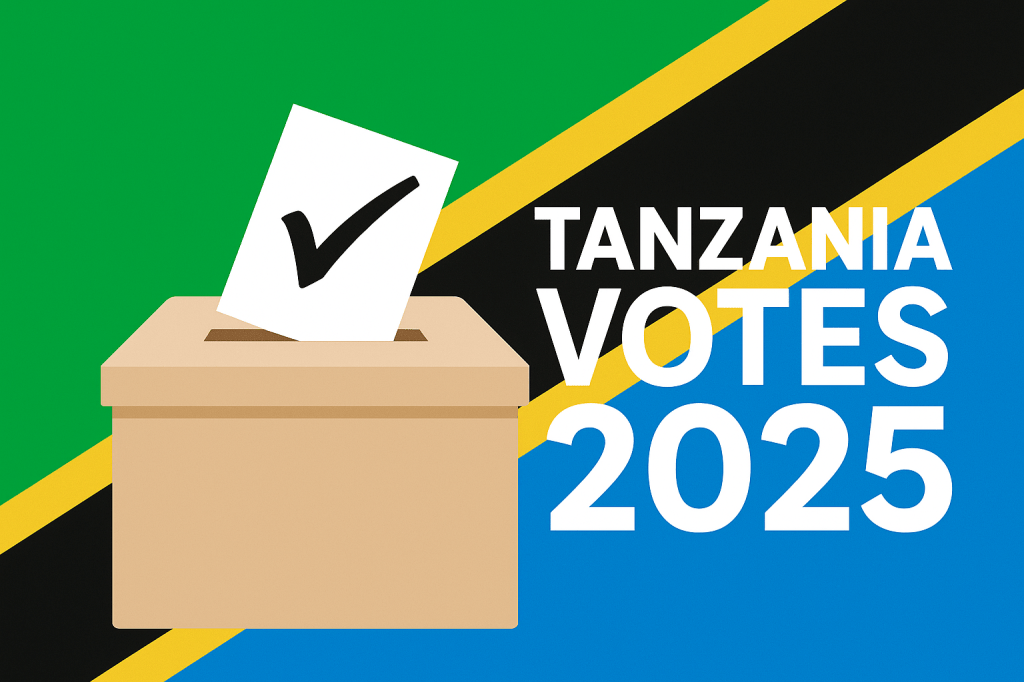
As Tanzania prepares for a high-stakes vote, Canada’s growing East African community is watching closely – not out of nostalgia, but because democracy abroad shapes life here too.
On October 29, 2025, Tanzanians will head to the polls in one of the most consequential elections in the nation’s history. But thousands of kilometres away – in Toronto, Calgary, and Edmonton – many in Canada’s East African diaspora will also be watching. For them, this isn’t just another African election. It’s a test of democracy, identity, and connection.
Tanzania has long prided itself as an island of calm in a volatile region – a country that largely avoided the ethnic and political violence that scarred many of its neighbours. Since independence under Julius Nyerere, its politics have carried a reputation for order and consensus, even under one-party dominance. But that image is under strain.
President Samia Suluhu Hassan, who took office in 2021 after the death of John Magufuli, has tried to reopen political space and repair relations with the opposition. Yet the ground remains uneven.
Rallies are still restricted, journalists face harassment, and Chama Cha Mapinduzi (CCM), the ruling party of six decades, continues to dominate institutions meant to safeguard fairness.
For Tanzanians abroad – including thousands living in Canada – these developments feel personal. Many left home during earlier periods of uncertainty, but their ties remain strong through family, remittances, and emerging business links. When democracy backslides, those connections ripple. The election also raises a question closer to home: what role should Canada play in supporting democracy abroad – especially where its own diaspora has a stake?
Ottawa has been recalibrating its engagement with Africa, promising deeper trade and development ties. East Africa, with its expanding economies and strategic geography, is a natural partner. Yet as Canada seeks stronger links, there’s both a moral and practical need
to champion democratic norms and transparent governance. Tanzania’s 2025 vote offers that test.
Diaspora communities can help bridge this gap. Across Canada, East Africans are hosting civic dialogues, cultural forums, and small business councils that link both regions. These efforts translate Canadian values of pluralism and accountability into action.
Still, many diaspora voices feel invisible in both countries – too “foreign” for Canadian
policymakers and too “distant” for African governments. Yet they are uniquely positioned to advocate for fair elections and responsible partnerships. The 2025 vote could become a rallying point for a new kind of diaspora diplomacy. This isn’t about imposing Western ideals. It’s about shared responsibility. When Tanzanian
journalists are silenced, it echoes in Canadian communities that cherish free expression. When elections lack transparency, investor confidence suffers – and remittances that sustain families are put at risk. But when citizens vote freely and institutions function, it strengthens
both the homeland and the diaspora that carries its story abroad. Canada’s East African community isn’t a spectator in this process. It’s a stakeholder – a living link between two democracies.
In a world where trust in institutions is eroding, Tanzania’s election reminds us that democracy requires both vigilance and empathy. As ballots are cast on October 29, many in Canada’s East African diaspora will feel the weight of hope and worry in equal measure – thinking not only of their homeland’s future, but of the
example it sets for generations learning to straddle two worlds: one that’s home, and one that’s watching.
About the author:
Msimulizi is a Toronto-based freelance East African-Canadian journalist and Member, National Ethnic Press & Media Council of
Canada.
Msimulizi is now on the Whattsup Channel. Click here
Msimulizi Community News uses artificial intelligence (AI) tools to assist with research, information gathering, infographic and illustrative images, and editing/polishing of some articles. Our journalists and editors remain responsible for the final content, verification and editorial decisions.
Discover more from Msimulizi Community News
Subscribe to get the latest posts sent to your email.


You must be logged in to post a comment.