
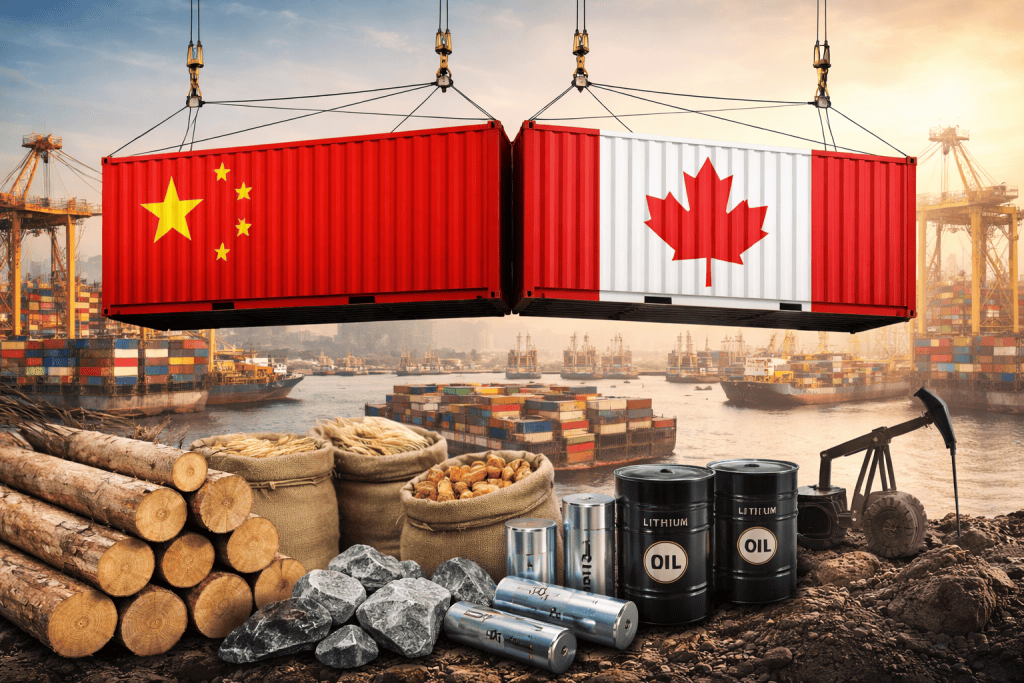
Prime Minister Mark Carney’s recent visit to China has been framed as a pragmatic effort to stabilize trade and expand Canada’s economic options. Viewed through a longer historical lens, however, the trip highlights a persistent feature of the Canadian economy: its continued reliance on exporting staples to external markets.
Political economist Harold Innis identified this pattern nearly a century ago in his Staple Thesis, arguing that Canada’s development was shaped by dependence on raw or semi-processed exports demanded abroad. While the staples have evolved, the underlying structure he described remains visible.
Canada’s economic relationship with China is largely defined by resource exports. Agricultural products, energy inputs, and critical minerals dominate trade flows, reinforcing a model centred on extraction rather than value-added production. Carney’s visit underscores this reality. China is economically significant less as a destination for Canadian manufactured goods than as a major consumer of Canada’s staples.
This model has delivered growth during favourable cycles but carries well-known risks. Staple-based economies tend to be vulnerable to global price fluctuations, slower to develop productivity-enhancing industries, and prone to uneven distribution of wealth. Canada’s current economic challenges reflect many of these characteristics.
Productivity growth has lagged behind peer countries, while manufacturing capacity has declined. Business investment remains weak, and capital has increasingly flowed into non-productive assets, particularly housing. Real estate now plays a central role in driving GDP growth and household wealth, even as affordability deteriorates and living costs rise faster than wages.
Exposure to external forces remains high. Global commodity prices influence government revenues and regional economies, while foreign interest rate decisions affect domestic inflation, household debt, and housing markets. Expanding trade ties with China may diversify export destinations, but it does little to reduce reliance on external demand.
Policy responses have focused more on managing this dependence than transforming it. Trade strategies have emphasized securing new markets for existing exports, including critical minerals linked to global supply chains. Carney’s China visit fits this pattern, prioritizing access and stability over structural change.
Canada retains important advantages, including a skilled workforce, strong institutions, and access to advanced technologies. The Staple Thesis does not suggest economic paths are fixed. It does, however, caution that without sustained investment in productivity, innovation, and domestic value creation, economies risk remaining locked into familiar patterns.
As geopolitical competition intensifies and global trade becomes more uncertain, Canada’s reliance on staple exports leaves it exposed. Engagement with China may offer near-term benefits, but it also raises a deeper question — whether Canada is broadening its economic foundations or extending a model that has long constrained its growth.
Msimulizi is now on the Whattsup Channel. Click here
Msimulizi Community News hutumia zana za akili bandia (AI) kusaidia katika utafiti, ukusanyaji wa taarifa, uundaji wa picha za infografia na vielelezo, pamoja na kuhariri na kuboresha baadhi ya makala. Waandishi wa habari na wahariri wetu wanaendelea kuwajibika kwa maudhui ya mwisho, uthibitishaji wa taarifa na maamuzi ya uhariri.

You must be logged in to post a comment.