Pip: Welcome to Msimulizi Community News — where a single flag raised over a city hall can carry the weight of two hundred million voices.
Mara: This episode covers three territories: the growing recognition of Kiswahili and Swahili heritage in Ontario, what the FIFA World Cup is revealing about belonging in Canada, and a political reconciliation in Zanzibar that is historic precisely because of who is no longer there to see it. All of it reported by msimulizi.
Pip: Let’s start with the flag, the bill, and the language that got there from Zanzibar by way of the Indian Ocean.
Swahili Heritage in Ontario
Mara: The question this segment answers is a practical one: what does official recognition of Kiswahili actually look like, and how close is Ontario to making it real?
Pip: The Brampton ceremony on July 12 put that question in sharp relief. Tanzania’s High Commissioner Joseph Sokoine stood at Brampton City Hall and made a concrete ask — the post quotes him emphasizing “the need for a cultural centre for the Swahili-speaking community,” naming Brampton as the ideal location.
Mara: That is not a ceremonial flourish. A cultural centre is infrastructure — space for language workshops, youth programs, the kind of sustained community life that outlasts any single flag raising.
Pip: And Brampton is already doing the groundwork. It was the first Ontario municipality to officially proclaim July as Swahili Heritage Month, which is how you get diplomats from Uganda, Zanzibar, and Tanzania all showing up to a square in the suburbs on a summer afternoon. Not a bad turnout for a language that Canadian institutions largely ignored a decade ago.
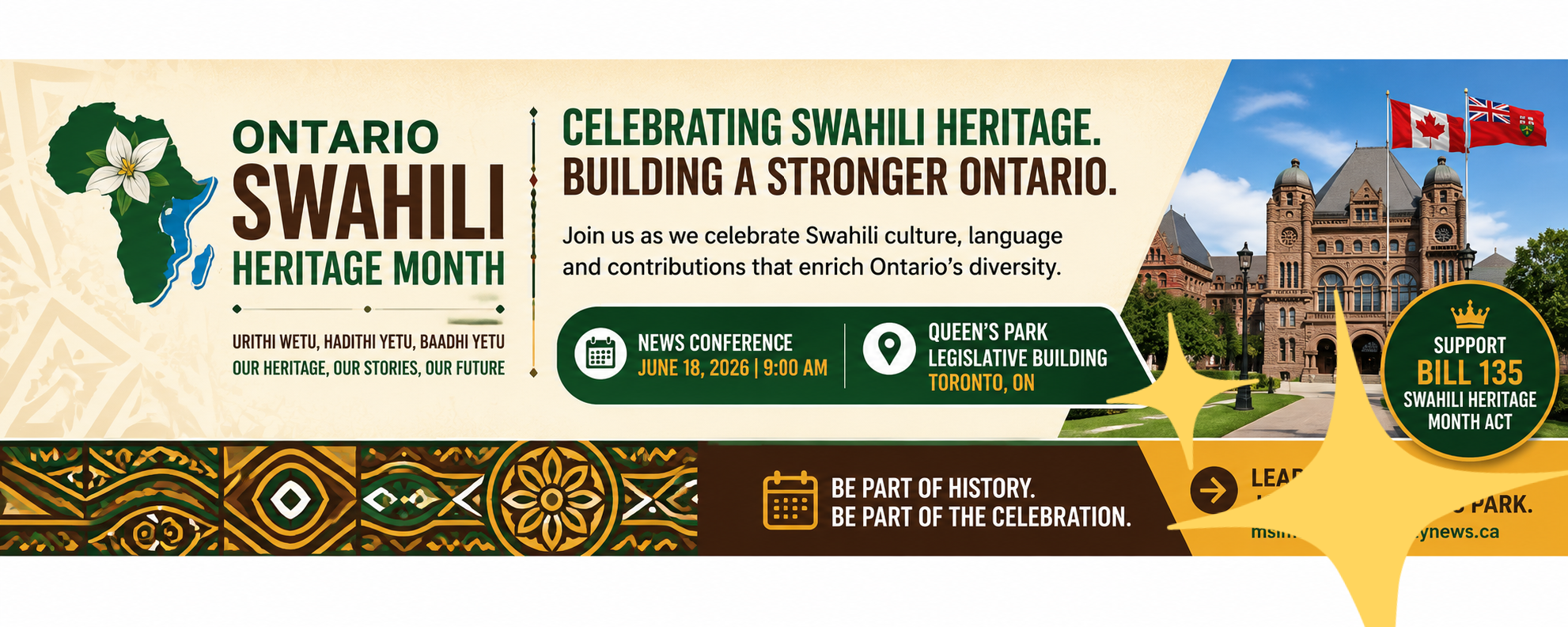
Mara: The legislative side is moving in parallel. Bill 135, the Swahili Heritage Month Act, 2026, was introduced at Queen’s Park on June 18 by Toronto Centre MPP Kristyn Wong-Tam. Khalid Magram, founder of Swahili Heritage Month, described the moment directly: “Today’s announcement is a proud moment for Ontario’s Swahili-speaking community. Bill 135, the Swahili Heritage Month Act, 2026, is now awaiting Royal Assent, bringing us one step closer to officially recognizing our language, culture, and contributions to this province.”
Pip: Royal Assent still pending — so the recognition exists, the momentum is real, and the finish line is visible but not yet crossed.
Mara: The piece tracing Kiswahili from Muscat to Ontario adds the global frame. UNESCO recognized July 7 as World Kiswahili Language Day in 2021 — the first African language to receive that distinction within the UN system. The 2026 observance ran under the theme “Kiswahili for Peace, Solidarity and Global Economic Diplomacy,” which positions the language as a tool for international cooperation, not just cultural heritage.
Pip: A language that absorbed Arabic vocabulary while keeping its Bantu grammar, carried across the Indian Ocean by trade winds, is now being debated in a legislature in Toronto. That is quite a commute.
Mara: The football crowds at Toronto’s fan festivals suggest belonging takes many forms — which is exactly where the next segment goes.
Football and Belonging in Canada
Mara: The photo essay from Toronto’s FIFA Fan Festival is making an argument: the World Cup is not just a tournament Canada is hosting — it is a mirror showing a football culture that immigrant communities built quietly for decades.
Pip: The frame the piece uses is a single image — a young fan at Nathan Phillips Square in a Portugal jersey. The post calls it evidence of something larger: “for many young fans, a football shirt is more than apparel — it’s a badge of belonging.”
Mara: The upshot is generational. Parents who kept their sporting traditions within their communities now have children wearing those same identities in public squares, alongside fans from every other continent. The crowd itself becomes the argument.
Pip: The piece ends with a challenge, though — sustaining this beyond the final whistle means investment in community pitches, youth academies, and grassroots programs. The enthusiasm is documented. The infrastructure question is still open.
Mara: From belonging on a football pitch to belonging in a political settlement — Zanzibar’s reconciliation effort raises its own questions about what comes after the ceremony.
Zanzibar’s Reconciliation Test
Pip: The 2026 Maridhiano — the reconciliation accord between CCM and ACT-Wazalendo — is significant for a reason that has nothing to do with its text: the man who defined this process for thirty years is gone.
Mara: The post frames it precisely: “For the first time in Zanzibar’s modern political history, a major reconciliation agreement between the ruling Chama Cha Mapinduzi and the opposition ACT-Wazalendo has been reached without the presence of the late Maalim Seif Sharif Hamad.”
Pip: What that means in practice is that a new generation of leaders now owns the outcome. Maalim Seif’s absence is not just symbolic — it removes the figure who gave the opposition side its credibility and continuity across every previous round.
Mara: Analysts cited in the piece agree on the core point: signing is easier than implementing. ACT-Wazalendo has already told its supporters to judge the process by results, not by the ceremony. Electoral reforms, oversight mechanisms, and the full text of the accord itself had not yet been publicly released at time of publication.
Pip: So the agreement exists, the signatories are named, and the clock is running on whether it becomes institutional change or another entry in a long list of symbolic milestones.
Mara: A flag over Brampton, a jersey in a Toronto square, a signed accord in Zanzibar — they are all asking the same question about what recognition actually costs to sustain.
Pip: More of that in the next episode. Stay with us.
Msimulizi is now on the Whattsup Channel. Click here
Msimulizi Community News hutumia zana za akili bandia (AI) kusaidia katika utafiti, ukusanyaji wa taarifa, uundaji wa picha za infografia na vielelezo, pamoja na kuhariri na kuboresha baadhi ya makala. Waandishi wa habari na wahariri wetu wanaendelea kuwajibika kwa maudhui ya mwisho, uthibitishaji wa taarifa na maamuzi ya uhariri.

You must be logged in to post a comment.