
Are African Governments Encouraging “Brain Drain”? The Migration of Skilled Professionals
By Khalid Magram | Msimulizi Community News
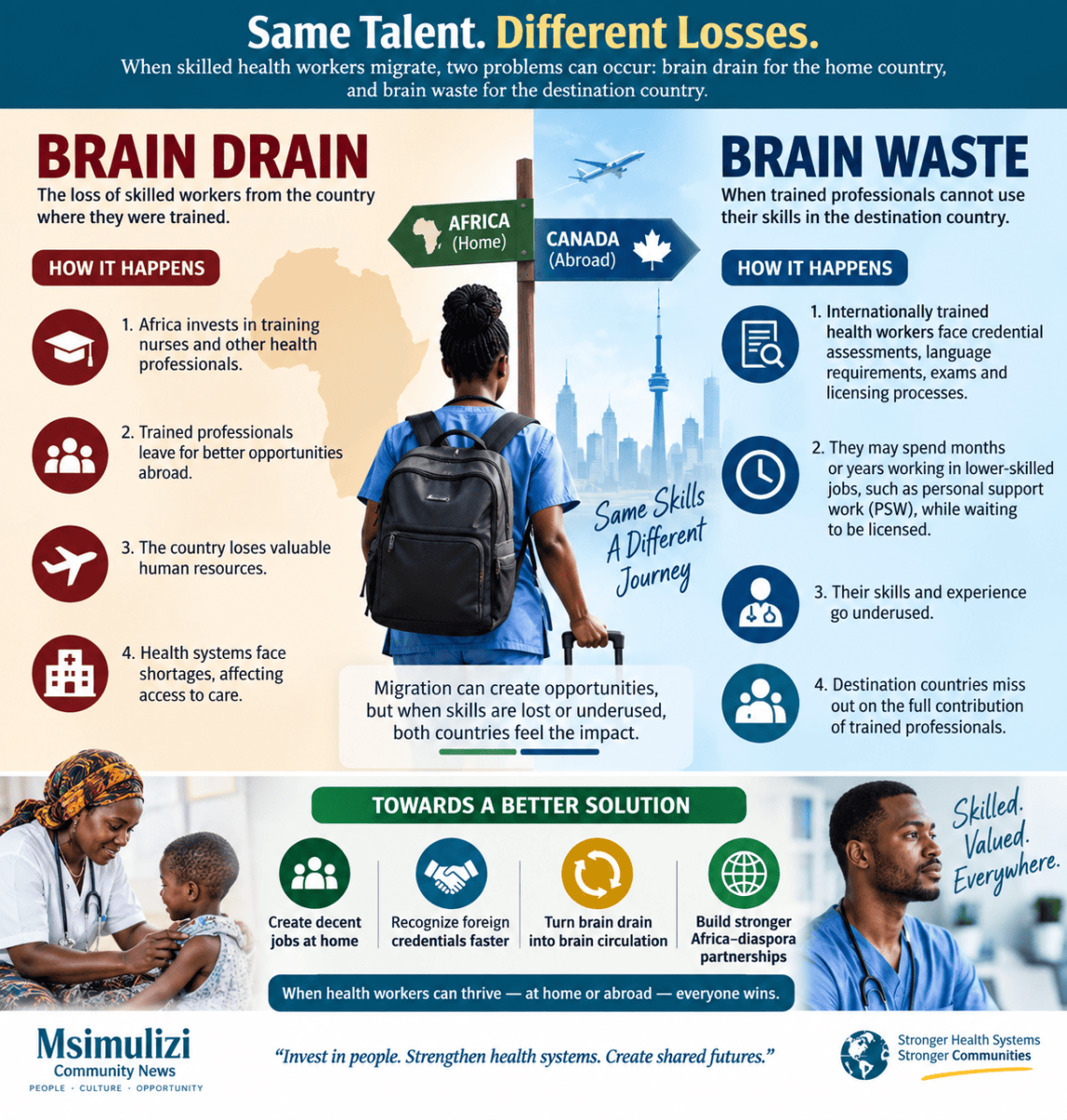
African countries are facing a serious shortage of health workers and other professionals in critical sectors. At the same time, these countries continue to train students and professionals who later leave to work abroad.Some African governments even provide loans or other forms of support for students to study overseas in countries such as the United Kingdom and Canada. Many of these students eventually remain in those countries rather than returning home to contribute the skills and expertise they have acquired.But is this simply a case of “brain drain”?Msimulizi’s examination of the issue found another dimension to the story.Some nurses and other health professionals trained in Africa who migrate to countries such as Canada cannot immediately practise in the professions for which they were trained.Instead, they may spend months or even years working in lower-skilled health-care positions—including as personal support workers (PSWs)—while they go through credential assessments, language requirements, examinations, professional registration and other licensing requirements.But there is another side to the story that deserves attention.The Economic Benefits of MigrationMigrants send money home. These remittances can support:- Parents- Children- Relatives- School fees- Housing- Businesses- Community development projectsRemittances can therefore provide an important economic lifeline for families and communities.Some skilled professionals who have migrated also maintain strong connections with their countries of origin. They return periodically to teach, provide training or contribute to health, technology and other development projects, sometimes through European organizations or through their own initiatives.A study involving 66 African doctors, nurses and midwives who had migrated abroad found that many maintained professional links with their countries of origin and participated in health, education or community-development initiatives.This suggests that migration does not necessarily have to mean a permanent loss of skills.Brain Drain — or Brain Waste?Msimulizi’s examination of the issue raises another important question: Could the problem be not only “brain drain,” but also “brain waste”?
BRAIN WASTE A key finding
Africa faces a shortage of health professionals. But the problem is also about employment opportunities—and whether countries create conditions that encourage trained professionals to remain. A 2026 WHO report indicates that Africa had approximately 5.72 million health workers in 2024, representing only about 46 per cent of the health workforce needed to meet the continent’s health-care requirements.At the same time, hundreds of thousands of trained health professionals struggle to find jobs that match their qualifications.For newly trained professionals, the situation can be particularly striking.Evidence cited by WHO indicates that:- 69 per cent of recently trained nurses were unemployed when they graduated.- 58 per cent of doctors- 46 per cent of midwivesHowever, these figures vary considerably from one country to another. They should therefore not be interpreted as meaning that 69 per cent of all nurses across Africa are unemployed. The figure refers to newly trained graduates in the evidence examined by WHO.This raises a broader question:Could improving employment opportunities in African countries transform migration from a permanent loss of skilled professionals into a temporary circulation of knowledge and expertise?And what responsibility do governments have to create conditions that make trained professionals want to remain in their countries—or eventually return home?
Part Two: The Solution?
This is where the conversation should continue. Rather than looking at migration only as a loss, African governments, diaspora communities and destination countries may need to examine how skills, knowledge, investment and professional networks can circulate between Africa and the diaspora.The question is not simply why professionals leave.It is also:What would make them stay?What would make them return?And perhaps most importantly:How can African countries turn their diaspora from a symbol of “brain drain” into a source of knowledge, investment and development?Your voice mattersWhat do you think?Should African governments focus more on creating employment and professional opportunities at home before investing in overseas education and training?Can the African diaspora become part of the solution?
Share your views.
Msimulizi Community News
Msimulizi is now on the Whattsup Channel. Click here
Msimulizi Community News hutumia zana za akili bandia (AI) kusaidia katika utafiti, ukusanyaji wa taarifa, uundaji wa picha za infografia na vielelezo, pamoja na kuhariri na kuboresha baadhi ya makala. Waandishi wa habari na wahariri wetu wanaendelea kuwajibika kwa maudhui ya mwisho, uthibitishaji wa taarifa na maamuzi ya uhariri.

Be the first to comment on "Are African Governments Encouraging “Brain Drain”? The Migration of Skilled Professionals"