
Bobi Wine Under House Arrest?
Wine’s party said that shortly after voting ended, military and police surrounded his residence in Kampala, effectively placing him under house arrest — claims that authorities downplay but have not fully refuted.
“These criminals even jumped over the fence and entered our compound,” Wine wrote on social media, insisting that his home remained besieged and that no one could enter or leave. “They do this because they are afraid of the people’s reaction after stealing their vote.”
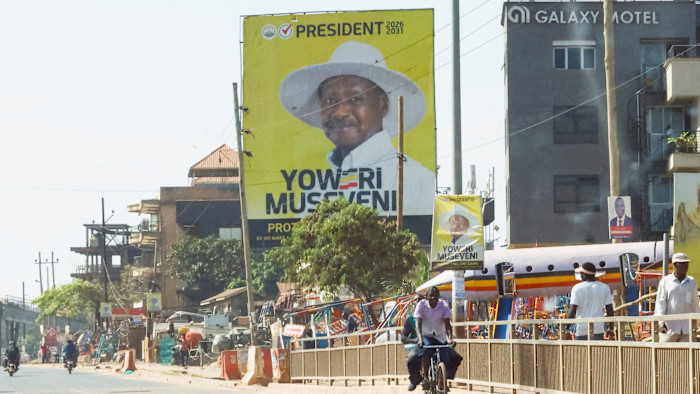
Kampala / Ottawa — Uganda’s long-serving President Yoweri Museveni appears on course for a seventh term following Thursday’s presidential election, as early results show him with a wide lead amid opposition allegations of fraud, post-election violence and a nationwide internet shutdown. Preliminary figures released by the Electoral Commission place Museveni far ahead of opposition leader Robert Kyagulanyi, popularly known as Bobi Wine. While final results are still pending, the opposition has already rejected the process, saying it lacked transparency and fairness.“This is not leadership — it is intimidation,” Kyagulanyi said in a statement, alleging that security forces surrounded his home shortly after voting ended. “They are afraid of the people after stealing their vote.”The government has denied wrongdoing. Officials defended heavy security deployment and a countrywide internet blackout, saying the measures were necessary to preserve peace. “The shutdown was meant to prevent misinformation and chaos,” a government spokesperson said.Civil society groups and observers criticized the move, arguing it cut off citizens from reliable information at a critical moment. “Elections should be conducted in the open, not behind closed digital doors,” said a regional human rights monitor.Voting day was also marked by late-opening polling stations, technical problems with biometric voter machines, and a strong military presence in several areas, particularly in opposition strongholds.Tensions escalated after polls closed. Police confirmed that at least seven people were killed during clashes with opposition supporters. While authorities blamed violent protests, opposition leaders accused security forces of using excessive force. “Our people are paying the price for demanding accountability,” said one opposition lawmaker.The developments have deeply unsettled the Ugandan diaspora in Canada, where families remain closely connected to events back home. “You keep calling relatives, but the phones don’t go through and the internet is down,” said Sarah Namulondo, a Toronto-based community organizer. “The fear is real.” Canada is home to tens of thousands of Ugandans, many of whom feel excluded from the electoral process. Uganda does not allow overseas voting, requiring citizens abroad to return home to cast ballots. “We send money home, we support families, but our political voice is missing,” said Michael Okello, a Ugandan-Canadian advocate in Ottawa. As Uganda awaits final results, opposition leaders are expected to pursue legal challenges while international partners urge calm. For Ugandans at home and in the diaspora, the election has once again highlighted unresolved questions about democracy, participation and the country’s future.
Msimulizi is now on the Whattsup Channel. Click here
Msimulizi Community News uses artificial intelligence (AI) tools to assist with research, information gathering, infographic and illustrative images, and editing/polishing of some articles. Our journalists and editors remain responsible for the final content, verification and editorial decisions.
Discover more from Msimulizi Community News
Subscribe to get the latest posts sent to your email.

You must be logged in to post a comment.